
Information Technology
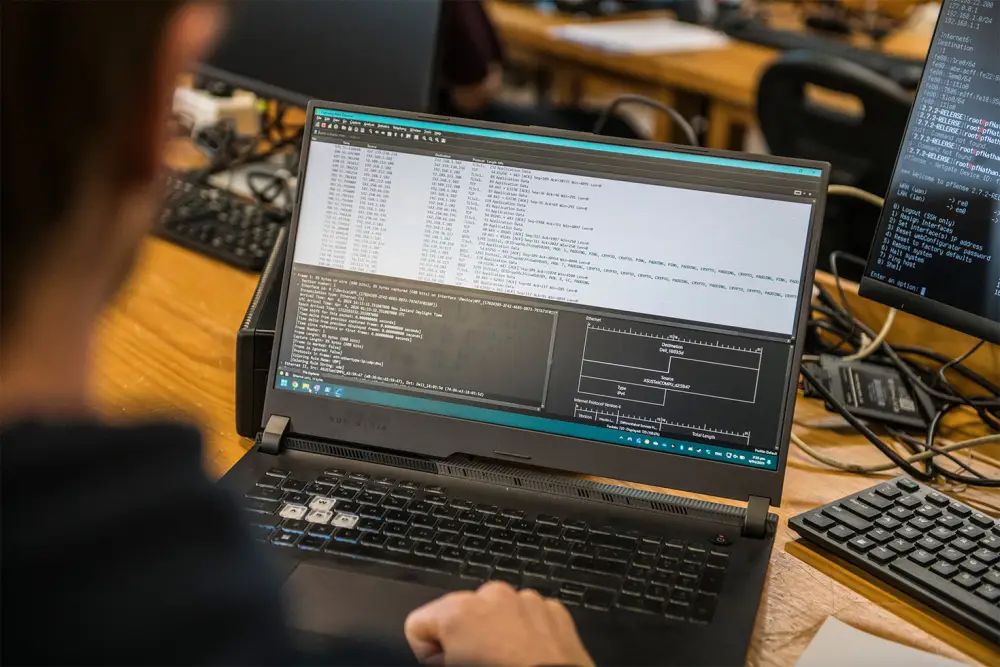
Staff investigate how cyber threats operate in practice, including the evolution of malware and AI-driven attacks, alongside secure system design and data protection in complex environments such as healthcare. Other research explores the optimisation of artificial neural networks, immersive and augmented reality applications, and innovative software development methods, including agile and design-based approaches. Projects include cybersecurity case studies and safe testing environments, AI-assisted software prototyping, 3D and augmented reality tools for education (such as viticulture training), and interdisciplinary work linking IT with areas like digital storytelling and visual effects production.
This research is closely integrated into teaching through hands-on, applied learning that reflects current industry practices. Students engage in activities such as cybersecurity labs, AI and software development projects, and the use of immersive technologies, gaining experience with real tools and challenges. Staff also contribute to improving IT education itself, with research into curriculum design, assessment, and the effective integration of AI into learning. Strong links to the profession ensure that teaching remains relevant and responsive to current needs, helping students develop practical skills, critical thinking, and adaptability for careers in cybersecurity, software development, and emerging technology fields.
For more information:
Master of Information Technology | Nelson Marlborough Institute of Technology (NMIT)(external link)
Research Staff in IT
-

Ali Kahwaji Information Technology Tutor
Ali Kahwaji’s research focuses on applied cybersecurity, with an emphasis on how security works in real systems rather than how it is described in theory. His work explores modern cyber threats, secure system design, and how organisations manage security and data protection, particularly where things go wrong in practice. His research is supported by postgraduate study in cyber security and includes interdisciplinary work in AI and healthcare, examining the intersection of security, ethics, and real-world constraints.
Ali uses this research to shape teaching that reflects real-world cybersecurity challenges. He brings practical insights into the classroom through case studies, hands-on labs, and “safe-to-fail” environments that help students understand system vulnerabilities and decision-making under pressure. His work also connects to industry by addressing gaps between theory and practice, supporting better security practices, and ensuring students are prepared for current and emerging cybersecurity roles.
-

Dr Todd Cochrane Information Technology Tutor
Todd Cochrane’s research spans education technology and the theoretical foundations of optimised computing for artificial neural networks. His work includes developing and testing hybrid design-based agile software methods in projects such as 3D technology for viticulture education, as well as exploring new teaching frameworks like the “Structured Flip to AI,” where AI-supported learning is guided by teachers. He also works on computing optimisation for neural networks and contributes to projects involving augmented reality, AI software prototyping, and digital storytelling.
Todd brings this research into teaching by developing and using real educational technology tools and methods in active learning environments. His work supports students in learning current IT practices through hands-on applications and emerging technologies. By combining research, teaching, and industry-focused development, he strengthens IT education and prepares students for advanced study and professional practice.
-
Serge Pashkevich Information Technology Tutor
Serge Taylor's research focuses on cybersecurity, with a long-standing interest in computer worms and how they evolve. His current work explores how artificial intelligence can be used in new types of cyber threats, particularly in adapting and changing malicious software to avoid detection. This reflects his broader interest in emerging technologies and the “offensive side” of cybersecurity.
Serge uses this research to keep teaching up to date with current and emerging threats in the cybersecurity field. By sharing real examples and developments, he helps students understand how attacks work and how they can be prevented. His work connects strongly to industry by ensuring students are aware of modern risks and prepared for roles in cybersecurity, where understanding evolving threats is essential.